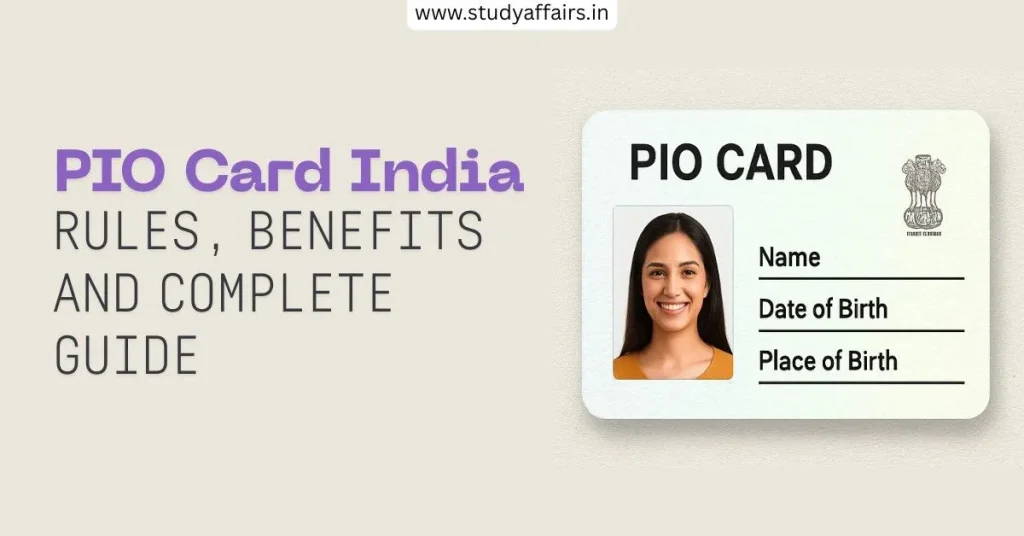
The PIO Card once held great significance for millions of people of Indian origin worldwide. It allowed them to travel, live, work, and invest in India with minimal bureaucratic hassle, while still retaining the citizenship of their resident country.
Although the PIO Card India scheme was officially discontinued in 2015, its impact and the privileges it provided remain an important part of India’s diaspora policy history. Today, former PIO cardholders benefit under the OCI (Overseas Citizen of India) scheme, which merged both programs into one.
In this detailed guide, we’ll cover:
- Full form of PIO
- Who qualifies as a PIO
- What is PIO Card
- Differences between PIO and OCI Cards
- Historical background
- Eligibility and benefits
- Discontinuation and conversion process
- 2025 travel rules for former PIO cardholders
Full Form of PIO
The full form of PIO is Person of Indian Origin.
This term refers to a foreign national who either:
- Has held an Indian passport at some point in the past, or
- Whose parents, grandparents, or great-grandparents were born in and permanently resided in India (as defined in the Government of India Act, 1935), or
- Is the spouse of an Indian citizen or PIO.
It’s important to note that certain countries are excluded from PIO status due to political and security reasons.
Who is a PIO?
A Person of Indian Origin (PIO) is legally recognized under Indian immigration law as someone with ancestral ties to India but holding a foreign nationality.
Eligibility for PIO Status
- Any foreign citizen (other than those from restricted countries) who has held an Indian passport in the past.
- Children, grandchildren, or great-grandchildren of a person who was born in and permanently resided in India.
- A spouse of a citizen of India or a PIO.
Restricted Countries (Not Eligible):
Nationals of Pakistan, Bangladesh, Nepal, Bhutan, Afghanistan, China, and Sri Lanka were not eligible for PIO status.
What is PIO Card?
A PIO Card was a special travel document issued by the Government of India to eligible foreign nationals of Indian origin.
It functioned as a long-term visa, allowing cardholders to enter India multiple times without having to apply for a visa for each visit.
Purpose of the PIO Card Scheme
- To strengthen India’s connection with its global diaspora.
- To encourage investment, tourism, and cultural exchange.
- To simplify immigration processes for PIOs.
PIO Card vs OCI Card
Both PIO Card and OCI Card aimed to connect the Indian diaspora with India, but they had different features:
| Feature | PIO Card | OCI Card |
| Validity | 15 years | Lifetime |
| Visa Type | Multiple-entry visa for 15 years | Multiple-entry, lifelong visa |
| FRRO Registration | Required if staying over 180 days | Not required |
| Political Rights | None | None |
| Employment Rights | Limited | Broader |
| Property Ownership | Allowed (non-agricultural) | Allowed (non-agricultural) |
History of the PIO Card Scheme
- 1999 – PIO Card scheme launched to facilitate easier travel for the Indian diaspora.
- 2002 – Benefits expanded to include property rights and education quotas.
- 2005 – OCI Card scheme introduced, offering lifetime validity and more benefits.
- 2014 – Prime Minister Narendra Modi announced the merger of PIO and OCI schemes to simplify procedures.
- 9 January 2015 – Official notification issued merging the PIO scheme into OCI.
Who Was Eligible for PIO Card?
Before discontinuation in 2015, the eligibility criteria included:
- Former Indian citizens (holding Indian passports earlier).
- Descendants up to the fourth generation of Indian citizens.
- Spouses of Indian citizens or PIOs.
Benefits of Being a PIO Card Holder
- Visa-Free Entry to India for 15 years.
- No Need for Frequent Visa Applications for business, tourism, or family visits.
- Property Rights – Ability to buy, sell, and own property in India (excluding agricultural land).
- Educational Benefits – Reserved seats in educational institutions under the NRI quota.
- Ease of Business – Eligible to open bank accounts, invest in Indian companies, and conduct trade.
Limitations of PIO Card
- No voting rights or eligibility for political office.
- No eligibility for government jobs in India.
- Certain restrictions on owning agricultural land.
- FRRO registration required for stays exceeding 180 days.
What is OCI PIO Card?
When the government merged the PIO scheme into the OCI scheme, it allowed all PIO Card holders to apply for an OCI Card free of cost.
OCI (Overseas Citizen of India) provides broader benefits, including:
- Lifetime visa to India.
- No FRRO registration requirement.
- Equal treatment with NRIs in many areas (except political rights).
PIO Card Discontinuation in India
On 9 January 2015, the Ministry of Home Affairs issued a notification discontinuing the PIO scheme.
Reasons for Discontinuation
- Simplification of visa categories.
- Avoiding duplication between PIO and OCI benefits.
- Making India more accessible to its diaspora.
Conversion of PIO Card to OCI Card
Step-by-Step Conversion Process
- Visit the OCI Services Portal.
- Select “OCI in lieu of PIO Card” option.
- Fill out the online application form.
- Upload scanned copies of:
- PIO Card
- Valid foreign passport
- Proof of Indian origin
- Recent photograph
- PIO Card
- Submit the application and note the reference number.
- Attend the appointment at the Indian mission/FRRO for verification.
- Receive the new OCI Card.
Important Deadlines
- Originally set for 31 March 2016, the deadline was extended multiple times.
- As of 2025, conversion is mandatory for travel to India.
Impact of PIO to OCI Merger on Travel
Before 2015, PIO Card holders could travel to India without much issue. Now:
- Only OCI Card is recognized for visa-free travel.
- Airlines and immigration authorities no longer accept PIO Cards as valid entry documents.
Practical Example:
Imagine Raj, a UK citizen whose grandparents were born in India. He held a PIO Card for years, visiting India every winter. After the 2015 merger, he had to apply for an OCI Card. Now, with the OCI, Raj enjoys lifetime multiple-entry visa privileges without worrying about visa renewals.
Latest 2025 Updates for PIO Card Holders
- All PIO Cards must be converted to OCI Cards to travel to India.
- PIO Card is no longer a valid travel document under ICAO rules.
- Conversion process is free of charge for current PIO Card holders.
Frequently Asked Questions (FAQs)
A: Person of Indian Origin.
A: A 15-year multiple-entry visa card for foreign nationals of Indian origin.
A: OCI is lifelong and offers more benefits, while PIO was valid for 15 years.
A: A foreign national with Indian ancestry, except nationals of restricted countries.
A: No, it must be converted into an OCI Card.
A: Apply online via the official OCI services portal with required documents.
Conclusion
The PIO Card India scheme played a key role in connecting India with its global diaspora. While it no longer exists, its benefits live on through the OCI Card, which offers even greater privileges, such as lifetime validity and visa-free travel.For the latest rules and application process, visit the Official MHA OCI Portal.
Click here to read this article in Hindi.


